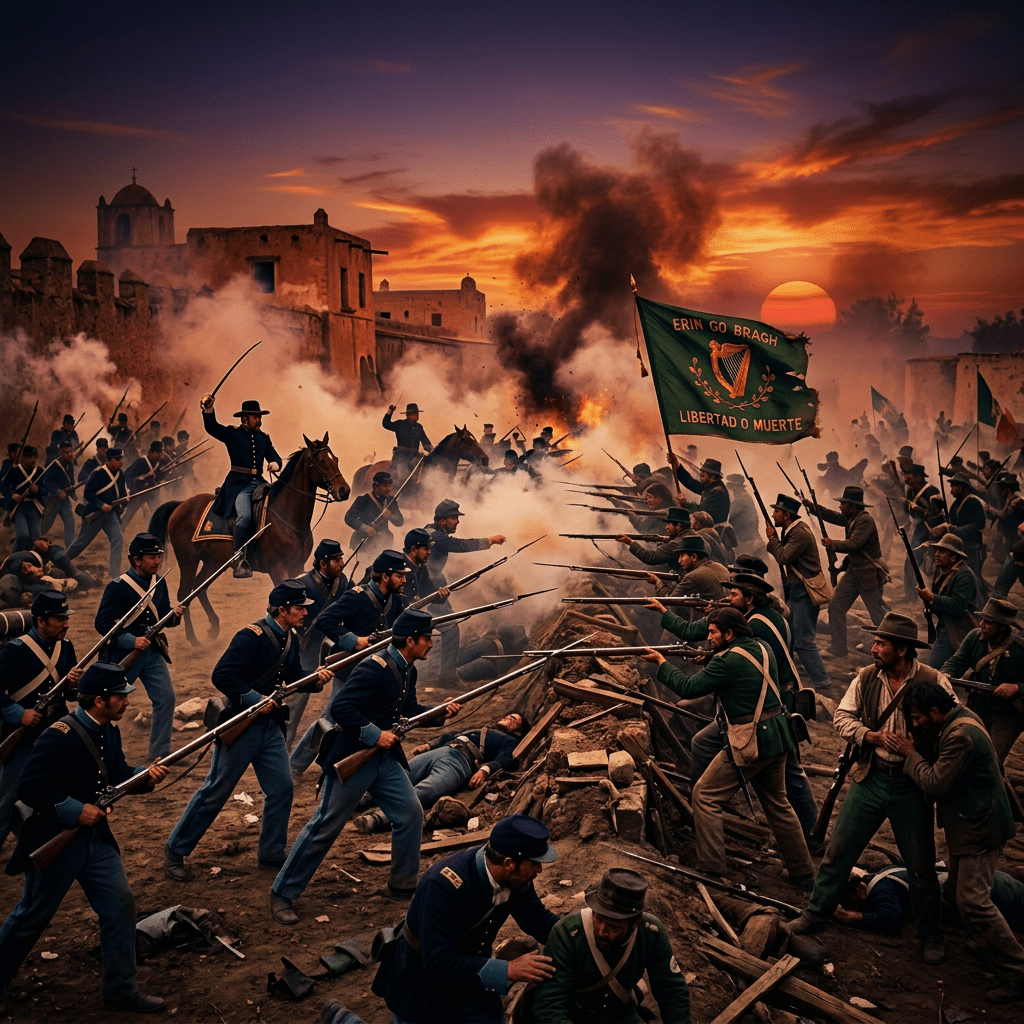
Identity, Loyalty, and Historical Interpretation in the San Patricio Battalion
Who gets to decide where you belong—and what makes leaving feel like betrayal? The expression-turned-catchphrase of the early 2020s, “I identify as…,” was a genuine attempt to claim authorship over identity—to push back against labels others assign from the outside and the expectation that people fit neatly into them. Yet even in that effort, the limits were hard to escape. To identify oneself was still to choose a label, to step into a box—just one self-selected—and wait for others to accept it or push back. In trying to loosen the grip of categories, it revealed how deeply we rely on them, exposing both our discomfort when people define themselves in unfamiliar ways and the tightness with which we continue to weave labels into our understanding of identity. Deciding where someone belongs lies in the space between self-definition and recognition. It is not done in isolation. You can choose where you stand—but belonging is negotiated, not declared.
For me, this question is not theoretical. I identify as Catholic, American, female, and politically independent, and I carry both European and Latin lineage. None of these identities mean the same thing twice; they shift with context, refracted through whoever is doing the reading. Catholics signal tradition, complicity, or moral controversy—occasionally interpreted as an uncritical adherence to religious authority as a source of security. Females carry long-standing expectations and constraints. Independent voters signal indecision. My identities overlap, contradict, and resist settling into anything fixed.
This instability makes it difficult to treat identity, loyalty, and moral obligations as fixed categories. It’s precisely this tension that shapes how I approach the case of the Irish soldiers who left the US Army during the US-Mexican War, fought for the Mexican cause, and formed the Batallón de San Patricio. Their decision to leave the US Army and fight with the Mexicans—labeled desertion, defection, or conviction depending on who’s telling it—feels less like distant history and, uncomfortably, more familiar.
The roots of the US-Mexican War stretch back to the Texas Revolution, when Anglo-American settlers challenged Mexican authority. Its annexation by the US in 1845 reignited tensions, particularly over the disputed border between the Nueces River and the Rio Grande. War broke out in 1846, shaped by Western expansionist ambitions and contested sovereignty.[1].
Desertion was not uncommon during the conflict; thousands of soldiers left the ranks of the U.S. Army, many of them foreign-born. In particular, the experience of Irish immigrants was formed by conditions that began long before their arrival[2]. Many had fled Ireland during the Great Famine, a crisis intensified by British policies that left them economically and socially vulnerable. Asenath Nicholson, an American traveler in Ireland during the famine, recorded widespread hunger and deprivation[3]. Military service in the United States offered opportunity but often came with harsh discipline and persistent anti-Catholic prejudice. Irish soldiers, many of whom were recent immigrants, were frequently treated with suspicion by Protestant officers and fellow soldiers, who questioned their loyalties and dismissed their religious practices. The Army limited access to Catholic clergy, and officers did not always support participation in Mass, reinforcing their status as outsiders within the ranks. Reports from the period suggest that Irish Catholics were more likely to receive severe punishment for infractions, further deepening a sense of unequal treatment.
According to former English soldier George Ballentine, that treatment was the strongest reason for desertion among the Catholics. He describes the punishment as degrading and barbarous, which “were exceedingly galling to the fiery, untamable spirit of the sons of the Green Isle.”[4] Humiliation does not foster belonging. Without belonging, loyalty cannot hold.
At the same time, the Mexican government actively sought to attract foreign-born soldiers serving in the U.S. Army. Mexican officials distributed appeals that emphasized shared Catholic identity, framing the conflict in both religious and political terms. These efforts were accompanied by material incentives, including promises of land, better pay, and more favorable treatment within the ranks.[5]. For Irish Catholics already experiencing marginalization, these offers presented an alternative that was both practical and ideological. Under these conditions, enlistment did not guarantee belonging, but Mexico offered a setting in which that gap appeared narrower.
Michel-Rolph Trouillot argues that history is not simply what happened, but what gets recorded, preserved, and told. Silences enter at every stage—from the creation of sources to the narratives historians construct[6]. In the case of the San Patricios, those silences shape historians’ understanding of their actions. To call them deserters, defectors, or men of conviction is not just a matter of interpretation, but of which voices are preserved and which are allowed to matter.
The Batallón de San Patricio was formed by John Riley, a Catholic Irishman who fled famine-stricken Ireland and first enlisted in the British Army. Stationed in Canada to defend British interests, he later left for the US Army—a move that, as he would come to realize, was less a break than a lateral shift within a familiar system. Yet service in the American ranks introduced new tensions, particularly as anti-Catholic sentiment and unequal treatment made belonging conditional. Within this environment, Riley’s eventual decision to leave the US Army and fight for Mexico reflects not a single decisive break, but the accumulation of pressures that made allegiance increasingly difficult to sustain[7].
How Riley’s decision is understood depends largely on perspective. In American accounts, the San Patricios are often remembered as oath breakers—men who abandoned their posts amid war. American Lieutenant Ralph W. Kirkham says in a letter to his wife, Katie upon hearing of their capture, “… and I presume they will all be hung, for shooting is too good for them.”[8] In Mexican narratives, they are honored as defenders, remembered for their role in resisting US invasion. Memorials like the one in Villa Obregón commemorate the rebel battalion for their sacrifice. A plaque hangs, “Con la gratitud de México a los 112 años de su sacrificio,” dated septiembre de 1959[9]. These competing interpretations reveal more about the frameworks used to judge it than about the act itself.
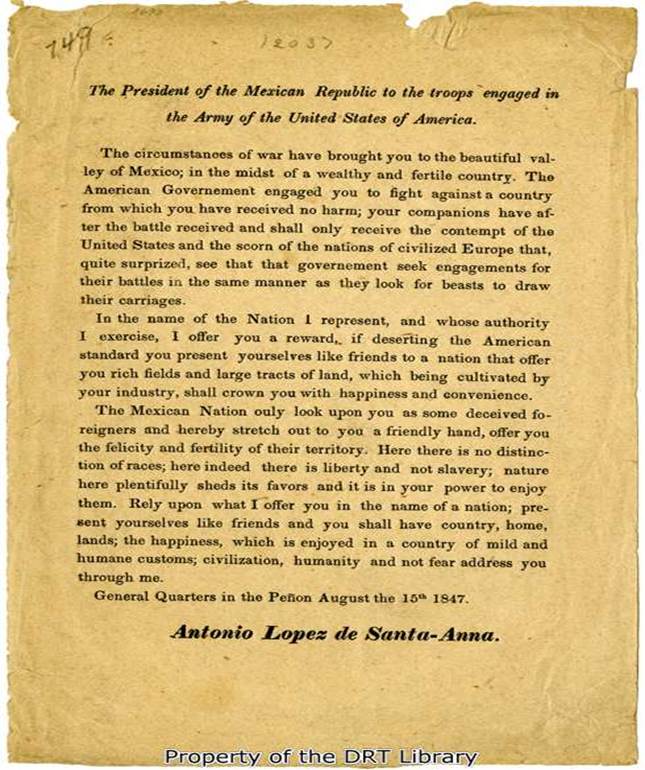
Religion played a central role in this process. For many Irish soldiers, Catholicism was not simply a private belief but a marker of identity that shaped how they were treated within the US Army. In Mexico, that same identity offered a point of connection and recognition. This did not resolve the complexity of their decision, but it did provide a framework through which belonging became accessible. Under these conditions, their shift in allegiance reflects not only material considerations but also the search for a context in which their identity was acknowledged rather than diminished. Here, in the following handbill, Santa-Anna does not try to manipulate with religion; it is only an opportunity to belong. An invitation stretched out with a “…friendly hand…” and “the felicity and fertility of their territory.”[10]
By acknowledging these complexities, historians study and write history more broadly. If identity and belonging are unstable, then the categories historians rely on—loyalty, betrayal, allegiance—require more scrutiny. The case of the San Patricios suggests that historical actors are often forced into narratives that prioritize clarity over complexity, flattening decisions that were shaped by competing pressures into labels that appear more definitive than they were. A reading of the past that allows for contradiction, rather than smoothing it over.
How we define belonging shapes how we assign loyalty—and, in turn, how we judge those who appear to betray it. The story of the San Patricios resists every categorization not because it lacks clarity, but because it exposes the limits of the categories themselves. To study their actions is not simply to ask what they did, but to confront how those actions have been interpreted, labeled, and remembered. In that sense, the question of where they belonged remains unsettled—not only in their time, but in the way their story continues to be told.
Bibliography
Ballentine, George. Autobiography of an English Soldier in the United States Army. New York: Stringer & Townsend, 1853.
Kirkham, Ralph W. Letter to his wife, 1847. Quoted in Robert Ryal Miller, Shamrock and Sword: The Saint Patrick’s Battalion in the U.S.-Mexican War. Norman: University of Oklahoma Press, 1989.
Miller, Robert Ryal. Shamrock and Sword: The Saint Patrick’s Battalion in the U.S.-Mexican War. Norman: University of Oklahoma Press, 1989.
Nicholson, Asenath. Annals of the Famine in Ireland. New York: E. Bliss & Co., 1851.
Santa Anna, Antonio López de. “The President of the Mexican Republic to the Troops Engaged in the Army of the United States of America.” Proclamation, August 15, 1847. Daughters of the Republic of Texas Library.
Stevens, Peter F. The Rogue’s March: John Riley and the St. Patrick’s Battalion. Washington, DC: Brassey’s, 1999.
Trouillot, Michel-Rolph. Silencing the Past: Power and the Production of History. Boston: Beacon Press, 1995.
[1] Michael Hogan, The Irish Soldiers of Mexico (Guadalajara, Mexico: Fondo Editorial Universitario, 2011), 31-35.
2 Peter F. Stevens, The Rogue’s March: John Riley and the St. Patrick’s Battalion, 1846-48 (Washington: Brassey’s, 1999), 2-3.
[3] Asenath Nichols, Annals of the Irish Famine (New York, New York: E. FRENCH, 135 NASSAU STREET., 1851), 178.
[4] George Ballentine, Autobiography of an English Soldier in the Untied States Army (Chicago: R.R. Donnelley & Sons Company, 1986), 332-333.
[5] Robert Ryal Miller, Shamrock and Sword: The Saint Patrick’s Battalion in the U.S.-Mexican War (Norman: University of Oklahoma Press, 1989), 64
[6] Michel-Rolph Trouillot, Silencing the Past Power and the Production of History (Boston: Beacon Press, 2015), 6.
[7] Robert Ryal Miller, Shamrock and Sword: The Saint Patrick’s Battalion in the U.S.-Mexican War (Norman: University of Oklahoma Press, 1989), 32-33.
[8] Ralph W. Kirkham, The Mexican War Journal and Letters of Ralph W. Kirkham, ed. Robert Ryal Miller (College Station: Texas A & M University Press, 1991), 52.
[9] Robert Ryal Miller, Shamrock and Sword: The Saint Patrick’s Battalion in the U.S.-Mexican War (Norman: University of Oklahoma Press, 1989), 178-179
[10] Antonio López de Santa Anna, “The President of the Mexican Republic to the troops engaged in the Army of the United States of America,” proclamation, August 15, 1847, Daughters of the Republic of Texas Library. https://drtlibrary.wordpress.com/wp-content/uploads/2009/08/sc-doc-1693-broadside-santa-anna-to-american-troops-1847-august-15wtmk.jpg
 The Spinster's Soliloquy

Leave a comment